

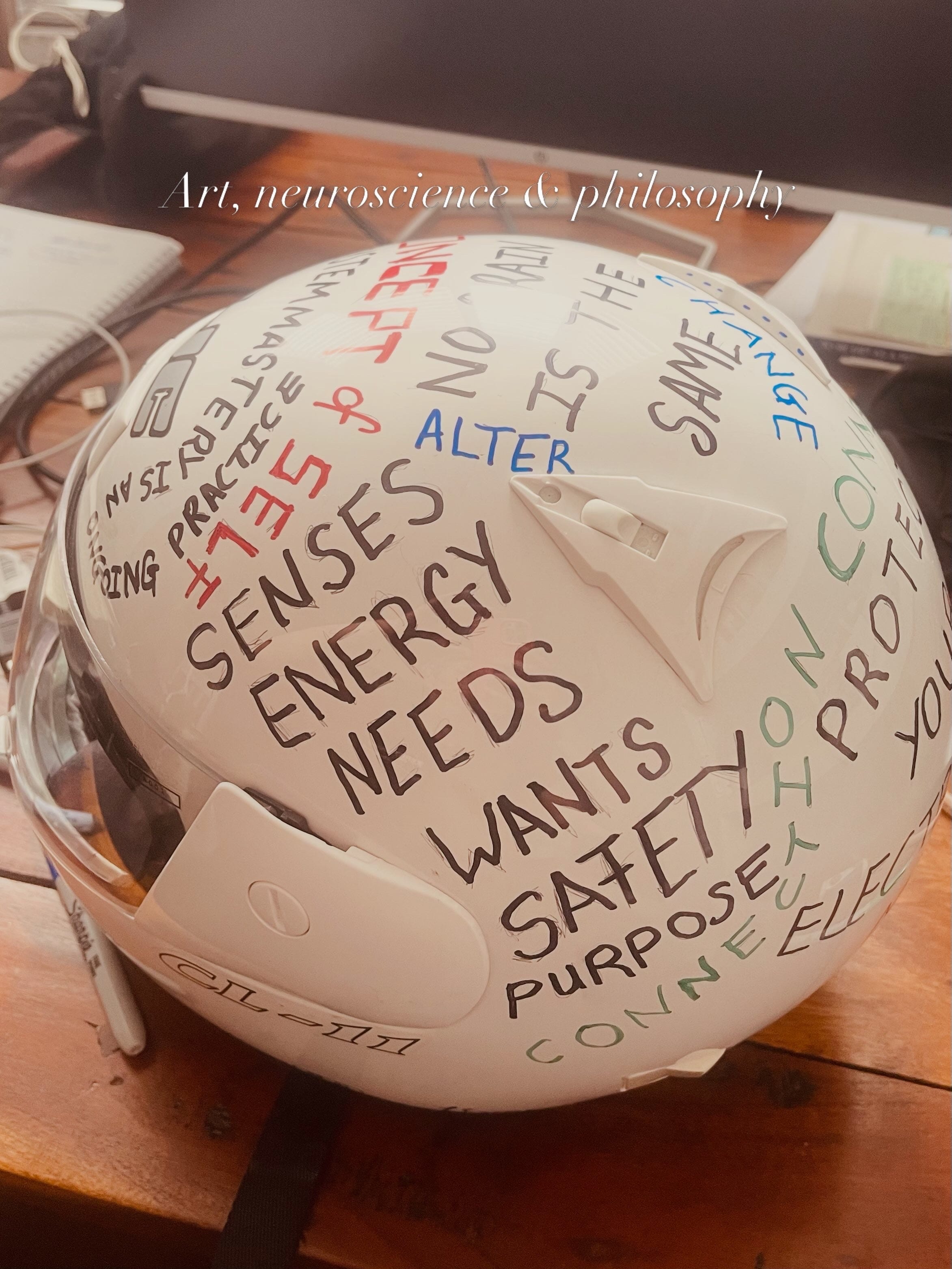
Earlier this month I was honoured to contribute to a dynamic art exhibition (created by Martina O’Shea) where individuals shared their works/passions (a poet, a writer, an art historian, etc) along with precious altars for the ever altering shop window display. The exhibition was called Alterity Altar. Alterity a philosophical concept meaning “otherness” outside of the self. It is a state of being different from others, from things. Altar derives from both latin meaning high (altare) and also to offer up (adolere) - a sacred place/ something meaningful. In parallel we can consider alteration, a word heavily associated with change. In essence alterity is best met with the ability to alter. Our sense of self and ultimately the civilisation we inhabit are governed by change.
The sense of self and civilisation can be connected by consciousness.
Consciousness has always been synonymous with human cognition, intellect and awareness. But the more science advances, the greater the depth of the philosophical exploration. For example the brain/nervous system is so complex that their parts have so many dynamic feedback loops it is virtually impossible to study in isolation. We can ditch the machine metaphor, we are more like the weather, multidimensional, certainly not deterministic like a domino chain.
Of course many reject the idea that consciousness is led by feeling/sensing rather than thinking, intellectualising per se. But to me it makes sense. We are sensing and feeling 24/7 both externally and internally, at its most basic level it ensures our survival and lends itself to more to ‘intuition’ than actually thinking about our ‘sense of self’, which is more ‘me, me, me’ based.
With this in mind we maybe have to reconsider consciousness being human or brain centric.
For example a common bacteria Physarum polycephalum (translated as many headed slime) is a colony of cells that merge together to form a single cell with numerous nuclei. They have no brain, no sensory organ, not even one neuron, yet they make complex decisions, demonstrate altruism and anticipate change. The research and real world application spans improving energy networks through to bio-inspired generative design. They even can be naughty- one researcher reported they checked out of their individual petri dishes to socialise as a massive blob on the lab ceiling.
Maybe consciousness features on a continuum, across living things, much like sensitivity does to the array of sensory data we continually process.
But can consciousness stretch to civilisation itself? Maybe. It has dynamic cycles, produces culture, which is alive and complex. Lets take a look at a recent but profound example within western civilisation. In 2024 the US Surgeon General declared loneliness a national epidemic. In the most ‘connected’ country in human history, a significantly large portion of the population reported ‘feeling’ alone. This feels very uncivilised although perhaps not surprising. Collectively we have built societies driven by the attention economy, where success is defined by shorttermist consumption and entertainment.
Also it may even be possible that like all life, civilisations goes through cycles (e.g. babyhood, adolescence, parenthood, middle-age, retirement / spring, summer, autumn, winter). This too makes sense no civilisation has lasted forever (e.g. Mesopotamia, Ancient Egypt, Aztec, Ancient China, Mali, Aksum & Roman).
Regardless of where consciousness is found or where the current western civilisation is in the cycle, humans themselves need deep meaningful connection, a sense of belonging not constant, instant stimulation. We need to be part of something that is greater than our sense of self and contribute to something that will be there long after we have gone, something art delivers time after time. I tried to express this with my offering for the window display (see main photo). I used the crash helmet as a powerful metaphor for protection, listing elements that contribute to the concept of self. As the crash helmet physically protects vital organs, we can metaphorically wear the protection keeping in mind key aspects like: our ability to change, our sense of purpose, sense of safety and the importance of connection.
No brain is the same: Embrace Alterity.